
Austin County Court Records After Arrest
Austin County court records after a jail arrest are not the same record as the Austin County Jail booking entry. The jail records intake, custody, holds, and practical bond information. The court file begins when a criminal case is opened and filed charges are assigned to a court record. The Austin County Sheriff's Criminal Investigation Division states that investigators compile factual cases for presentation to the District Attorney's Office for prosecution. That link matters because a booking charge is often an early label, while a prosecutor decides what charge, if any, is filed in court.
The local prosecution office is the Austin County Criminal District Attorney. The county page identifies Brandy Robinson as Criminal District Attorney, responsible for overseeing prosecution of criminal offenses that occur in Austin County, and states she took the oath of office on April 24, 2025. A court record after arrest may show a complaint, information, indictment, setting, bond order, warrant action, plea, dismissal, deferred disposition, or sentence. For custody and booking details, use Austin County jail inmate records. For booking photos, use Austin County jail mugshots and the sheriff records request route.
The county's own public access screenshot source is the Austin County Tyler Public Access portal, linked by the County Clerk and District Clerk pages.
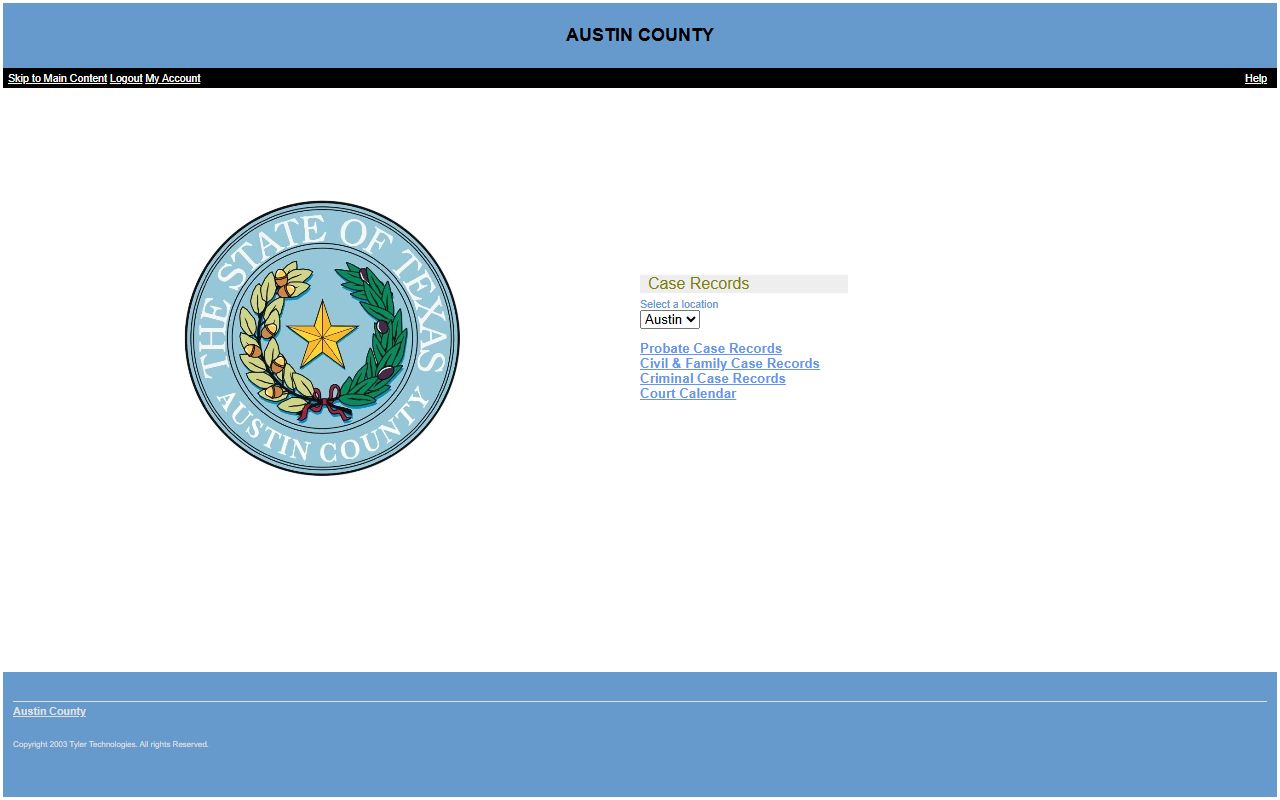
The portal may redirect through a session or login flow, so the clerk pages remain important starting points when a direct session link does not load cleanly.
Find Austin County Court Records
The Austin County District Clerk page links "Public Access to Records" to Tyler Public Access, and the Austin County Clerk page also links the same public records system for clerk records. Research found repeated session redirects when the Tyler URL was inspected directly, so a user may need to start from the official clerk pages and let the site create a browser session. The case search fields were not fully inspectable from the research environment, so no unverified field labels should be assumed. Use the defendant's legal name, known case number, citation number, or court date only when those options appear in the portal.
- Open the Austin County District Clerk page or the Austin County Clerk page.
- Follow the county-linked public access record link into the Tyler portal and allow any normal browser session to load.
- Search by the available case or party fields, then compare the name, offense level, court, and filing date before treating a result as the right case.
- Open each matching case and read the charge list, bond entries, setting history, disposition, and any warrant or capias notes that are public.
- If the arrest is too new for a case to appear, call the Austin County Jail for custody and bond status and check again after filing.
County Clerk Diane Day's office is listed at 265 N. Chesley Street, Ste. #7, Bellville, TX 77418. The office phone is 979-227-3144, email is countyc@austincounty.com, and published hours are Monday through Thursday, 8:00 am to 4:30 pm, and Friday, 8:00 am to 12:00 pm and 1:00 pm to 4:30 pm. The District Clerk page uses the courthouse location at One East Main Street in Bellville. Court copies and clerk questions should follow the clerk office's rules, while sheriff investigative or booking records belong with the sheriff's open records process.
The County Clerk page is a separate official source for Austin County court records and clerk contact details.

Use the clerk source for court-file copy routing, not for live jail custody questions.
Austin County Arrest Charge Filing
An arrest can begin with probable cause, a warrant, or an officer's allegation, but an Austin County court record after arrest depends on a charging document. In plain terms, a charging document tells the court what crime the state says occurred and who is accused. The wording can differ from the jail booking label because the prosecutor may decline, amend, reduce, enhance, or dismiss the charge after reviewing reports, witness statements, evidence, and criminal history.
| Document | Who Uses It | What It Means |
|---|---|---|
| Complaint | Officer or prosecutor | A sworn allegation or probable-cause document that can support an arrest or a misdemeanor case. |
| Information | Prosecutor | A prosecutor-filed charge, common in misdemeanor practice and some cases allowed by Texas procedure. |
| Indictment | Grand jury | A felony charging document returned by a grand jury unless the process is waived or another lawful path applies. |
The District Attorney page provides the prosecution bridge for this step, while the sheriff CID page supplies the investigative bridge. A booking can be quick. A court filing may take longer. If no case appears in Austin County Tyler Public Access, the result may mean the case has not been filed yet, is filed under a different spelling or cause number, is restricted, or belongs in another court or county.
The Austin County District Attorney page identifies the office responsible for criminal prosecution.

That office role explains why jail booking terms can change before the final court charge appears.
Austin County Charge Status
Charge status is the court record's current answer to what happened to a count. It is not a moral label and it is not always final. A single Austin County arrest can lead to several counts with different results. One count may be dismissed, another amended, and another still pending. The safest way to read court records after arrest is one count at a time, with attention to the cause number, filing date, offense level, court, and disposition date.
| Status | Meaning in the Court Record |
|---|---|
| Pending | The charge has been filed and no final public outcome is shown for that count. |
| Amended | The prosecutor changed the pleading, wording, offense level, or charge description. |
| Reduced | The charge was lowered to a lesser offense or lesser level. |
| Dismissed | The charge ended without a conviction on that count. |
| No-billed | A grand jury did not return an indictment on the felony allegation. |
| Convicted or adjudicated | The court recorded a guilt finding, plea result, deferred disposition, probation, or sentence, depending on the case. |
Terms such as "disposed" can be broad. They may mean the case has a recorded outcome, but the exact outcome still needs to be read from the docket or judgment. If a public portal entry is unclear, the clerk is the better source for copies and docket interpretation limits. Clerks can provide records, but they do not give legal advice.
Austin County Arrest Bond
Bond after an Austin County arrest is governed by Texas Code of Criminal Procedure Chapter 17 and by court or magistrate action in the case. The jail page does not publish a detailed bond-payment page, kiosk vendor, payment methods, or posting hours. That means the practical route is to call the Austin County Jail at 979-865-5321, confirm the current bond amount and cause number if known, and ask whether any other hold prevents release. The court record may later show bond changes, forfeiture, or a warrant issued after a missed setting.
| Bond Type | How It Works in Plain English |
|---|---|
| Cash bond | The full cash amount is posted with the authorized office or court, subject to court rules. |
| Surety bond | A licensed bond company posts the bond for a fee and may require collateral. |
| Personal recognizance bond | The court releases the person on written promise and conditions without full cash deposit. |
| No-bond hold | The person cannot be released on ordinary bond until the issuing court changes the hold. |
| Detainer or hold | Another agency, warrant, parole matter, immigration issue, or case may block release. |
The sheriff's April 2024 news release gives a local example of how these entries can change. It described a failure-to-appear event, a requested bond forfeiture, a judge-signed warrant with no bond, separate later charges, and separate bond amounts. The release also used presumption-of-innocence language, which is the right frame for court records after jail arrest. Arrests and indictments are allegations until a lawful conviction or other final outcome is entered.
Austin County Warrant Records
The Austin County Sheriff's Office has an official Warrants page, but research did not find a public searchable active-warrant list or search fields on that page. Warrant questions therefore depend on the sheriff's office, the jail after booking, the relevant court, Tyler Public Access when a court case exists, or an open records request when a public record is releasable. Do not assume the absence of a web listing means no warrant exists.
Warrant terms are easy to confuse. An arrest warrant authorizes arrest on a criminal accusation. A bench warrant or capias is often tied to failure to appear or violation of a court order. A search warrant authorizes a search of property and is not a person's custody status. If a person has already been arrested on a warrant, the jail phone is the current custody starting point. If a person believes an active warrant may exist, an attorney or the issuing court is the safer path before travel.
Austin County Charges vs Convictions
A charge is an accusation in a court record. A conviction is a court outcome after a plea, verdict, or other qualifying judgment. Austin County court records after arrest can show both, but a reader must not treat them as the same thing. A dismissed charge may still appear as part of the case history unless it is later sealed, restricted, or expunged under a court order.
| Issue | Charge | Conviction |
|---|---|---|
| Case stage | Filed accusation after arrest review | Final or recorded court outcome |
| Legal meaning | The state alleges an offense occurred | The court records guilt, plea result, or qualifying adjudication |
| Can change | May be amended, reduced, dismissed, or no-billed | May be appealed, modified, or later affected by record-clearing orders |
| How to verify | Read the filed charging document and docket | Read the judgment, sentence, disposition, or clerk-certified copy |
Austin County Sealed or Expunged Records
Texas record-clearing rules are specific. Texas Code of Criminal Procedure Chapter 55 covers expunction, which can allow eligible arrest or case records to be removed or treated as not existing for many public purposes. Sealing, often discussed as nondisclosure, is different. It can restrict public access while leaving controlled access for certain agencies. Eligibility depends on the charge, outcome, timing, criminal history, and court order.
| Issue | Sealed or Nondisclosed | Expunged |
|---|---|---|
| Public visibility | Hidden or limited for most public searches | Removed or treated as not existing under the order |
| Agency access | Some agencies may retain limited access | Access is much more restricted and order-driven |
| Best proof | Court order and clerk record | Expunction order and proof of service on agencies |
| Common trigger | Eligible disposition under Texas law | Dismissal, acquittal, no-bill, pardon, or other eligible result, depending on facts |
Juvenile records, sealed matters, some dismissed cases, and active investigations may not be visible in ordinary public portals. Texas Government Code Chapter 552 is the public information base for government records, but law-enforcement exceptions and privacy rules can limit release. Government Code 552.108(c) preserves access to basic information about an arrested person, an arrest, or a crime, but that does not make every investigative file public.
Austin County Record Limits
Court records after arrest are useful for case tracking, but they are not a substitute for a compliant criminal-history check. Statewide criminal history should be obtained through official Texas Department of Public Safety channels when that is the required source. Private name searches can miss aliases, sealed records, expunged records, out-of-county cases, and updates after a disposition. A clerk-certified copy is stronger than a screen view when proof of a filing or outcome is needed.
Important: Austin County Inmate Population is not a consumer reporting agency and may not be used for FCRA-covered decisions.